From Sketch to Screen: Unlocking the Creative Potential of 50 Hand Drawn Floral Elements
For creators, the digital landscape is both a canvas and a marketplace. Whether you're designing a heartfelt greeting card, branding a new wellness business, or creating patterns for a textile project, the foundation of your visual story often starts with the right assets. A collection like 50 Hand Drawn Floral Elements isn't just a bundle of files; it's a versatile toolkit designed to bypass the limitations of rigid, uniform clip art and inject authentic, organic charm into your work.
The Allure of Authenticity in a Digital World
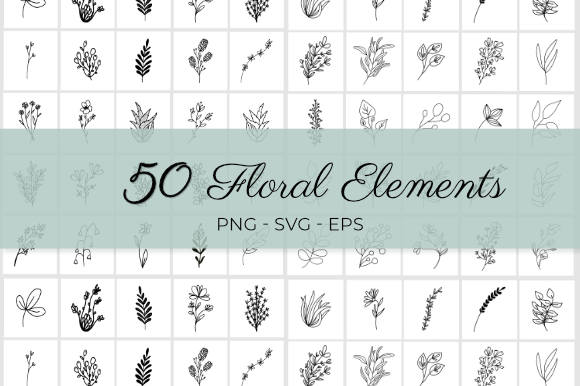
Why would a marketer, a small business owner, or a hobbyist gravitate towards hand-drawn elements? The answer lies in communication. In a space saturated with polished, vector-perfect graphics, a hand-drawn style conveys warmth, personality, and approachability. These 50 individual floral sketches—each a unique stem, leaf, blossom, or bud—allow you to build compositions that feel crafted, not assembled. They’re ideal for projects where you want to evoke feelings of nostalgia, artisanal quality, or natural beauty. With provided file formats including EPS for scalable vector editing and high-resolution PNGs at 5000x5000px and 300 DPI, they bridge the gap between artistic sketch and professional-grade asset.
Common Oversights When Choosing Digital Asset Bundles
Many creators, especially those pressed for time, make selection decisions based solely on thumbnail previews or quantity. This can lead to several practical frustrations down the line.
Mistake 1: Assuming "Floral Elements" Means Complete, Ready-Made Arrangements
A significant misunderstanding is treating a pack of elements like a collection of finished illustrations. If you expect the 50 Hand Drawn Floral Elements to be 50 pre-composed bouquets, you’ll be disappointed. This collection is fundamentally a construction set. The value is in the combinatorial possibility—the 50 separate parts that you, the designer, mix, layer, and color to create thousands of unique arrangements. The better approach is to see it as a raw material, like a palette of paints or a set of building blocks. Before purchasing any asset pack, scrutinize the listing’s description and sample images to verify if it offers individual components or finished scenes.
Mistake 2: Neglecting File Format Compatibility with Your Workflow
Not all software reads all files. A professional using Adobe Illustrator for logo design will prioritize the EPS vector files. A blogger working in Canva or a basic image editor might rely solely on the PNGs. A common error is downloading a bundle only to discover your primary tool cannot effectively use the core formats. With this collection, you receive both EPS and PNG (including transparent background versions), covering a wide range of applications from print to web. The practical advice is to audit your standard design processes. What software do you actually use daily? Ensure the included file types—not just the advertised number of files—are a direct match for your creative environment.
Mistake 3: Overlooking Scale and Resolution Requirements
Imagine using a beautiful floral element for a logo, only to find it pixelates when printed on a large banner. Or using it for a detailed wallpaper pattern, where low resolution results in a blurry, unprofessional finish. The specifications here—5000 x 5000 pixels at 300 DPI—are deliberately generous to prevent this. They allow for scaling up to large print formats and down to tiny social media icons without quality loss. A better choice is to always check the technical specs before buying. Compare them to the maximum output size you foresee for your projects. For textile or wallpaper design, where repetition and scale are critical, this high-resolution foundation is not just nice; it’s necessary.
Applying the Elements: Beyond the First Idea
Even with the right assets in hand, their potential can be underutilized. One typical creative block is using each element in isolation, simply placing a single flower on a card. The power of a 50-piece set is in layering and recombination.
Building Complexity from Simplicity
Start by grouping a few stems and blossoms to form a small cluster. Use the transparent PNG files to overlap them without harsh edges. Then, duplicate that cluster, rotate it, change its color using your editing software, and build a repeating pattern for a website background or textile swatch. The EPS files let you ungroup individual flower parts within a vector editor, allowing you to recolor petals and stems independently for a fully custom palette. This approach transforms a limited set of 50 items into a near-infinite library. For a greeting card series, you can use the same base elements but arrange them differently for each card, creating a cohesive yet varied brand aesthetic.
A Warning on Color and Context
These elements are typically provided in a single color (often black line art), which is a feature, not a limitation. It gives you maximum control. A mistake is to leave them as monochrome without considering the final context. A floral logo for a children’s brand might need bright, cheerful colors, while decor for a minimalist spa might require muted, earthy tones. Before applying them, define the emotional tone and color scheme of your final project. Use the vector or image editing tools to colorize the elements harmoniously. This extra step ensures your floral designs don’t clash with the overall message you’re trying to convey.
Evaluating Value Before You Download
In a market full of digital assets, making a constructive decision requires looking beyond the price per file.
First, consider application breadth. Can these 50 Hand Drawn Floral Elements serve multiple projects across your year? A logo today, a blog header next month, and holiday card art in December? Their versatility across print, textile, and digital decor makes them a durable investment.
Second, assess editability. The presence of vector EPS files means you are not locked into a fixed shape or size. You can adjust line weights, modify shapes slightly, and integrate them with other vector elements for logo design. This is crucial for professionals needing to tailor assets to precise brand guidelines.
Finally, gauge the style alignment. Hand-drawn does not mean messy or unprofessional. Review the sample images closely: does the sketching style match the aesthetic you (or your clients) prefer—perhaps whimsical, gentle, or botanical? Ensuring this stylistic fit upfront prevents the frustration of having assets that feel “off-brand” and sit unused in your digital library.
By approaching this collection not as a quick fix but as a foundational toolkit, you empower your creativity. You avoid the common pitfalls of incompatible formats, misunderstood scope, and underutilized potential. These 50 individual sketches become the seeds from which you can grow endless, unique, and authentically beautiful design compositions, saving time while elevating the personal touch in all your creative work.